Growth is usually the goal of any company. The problem is that growth doesn’t always mean progress.
As companies launch products, enter new markets, or acquire businesses, their ecosystem becomes more complex. And without structure, what began as a clear vision ends up as an accumulation of brands, sub-brands, and messages that compete with one another, confuse consumers, and erode the value of the business. From the inside, every decision seems logical. From the outside, the whole thing makes no sense.
Brand architecture. Growing without losing consistency.
How to organise brands and products to grow your business clearly and without causing confusion.
Growing is not about accumulating.
Growing is about evolving with structure.
This is where brand architecture comes in. A branding discipline that operates behind the scenes, yet shapes the future of companies. It is not a naming exercise or a matter of aesthetics; it is a strategic management tool.
Brand architecture defines how an ecosystem is organised so that every brand, sub-brand or product has a clear role within the whole. It is the map that establishes where one brand ends and the next begins; what they must all reinforce and which elements require their own identity.
The aim is for everything to contribute towards the same goal.
Because although internally each decision may seem isolated, the market perceives everything as a whole. And if that whole lacks coherence, confusion arises.
There is no single way to establish an architecture. Every business needs its own system.
Some companies opt for monolithic structures, where a single brand concentrates all the power. Others operate with independent brands that coexist without interfering with one another. And there are endorsement models or hybrid systems that combine different levels of prominence depending on the market or the product.
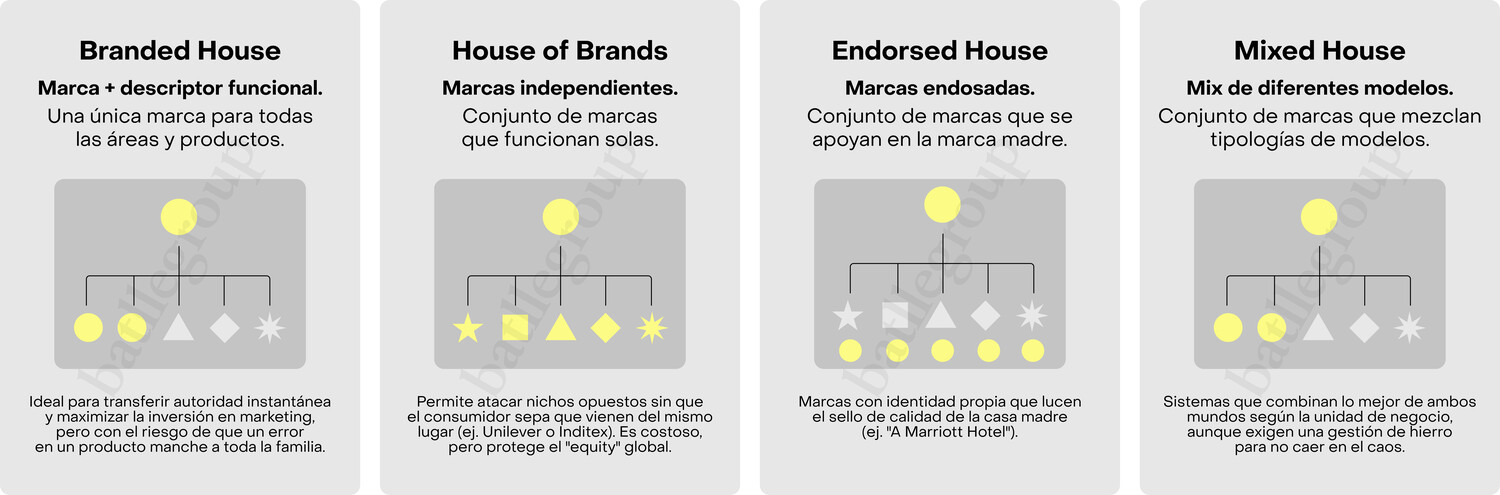
But beyond the technical terminology, the objective is always the same: to organise in order to make sense of things.
Working on the architecture means clearing away the clutter so that every brand, sub-brand or product has a defined role and its own space. It means ensuring that no piece on the board cannibalises the others.
It is worth distinguishing between two concepts that are often confused. Brand architecture defines the strategic logic of the system: how brands are organised and relate to one another. Portfolio architecture translates that logic to the market: how products coexist and are presented within each range. These are two distinct conversations that must be aligned.
From strategy to portfolio
Throughout our history, at Batllegroup we have supported numerous companies through this process, from defining global hierarchies to the visual organisation of complex portfolios.

For Signal France, for example, we developed the portfolio architecture and design for the Sensibilité range. The challenge was to clearly differentiate the varieties without compromising the brand’s consistency. The solution was a visual system in which the premium range stands out with a more sophisticated and upmarket aesthetic, whilst remaining true to the parent brand’s identity.
When the architecture is well thought out, the portfolio stops competing with itself and begins to function as a coordinated ecosystem.
This translates into very concrete benefits:
- Clarity. The user understands the ecosystem at a glance.
- Scalability. New products can be incorporated without disrupting the whole.
- Efficiency. Strategic and creative decisions become more agile and consistent.
- Brand value. Each launch reinforces the system rather than fragmenting it.
And when this structure is accompanied by a strategic design aligned with a strong brand, the impact is tangible.
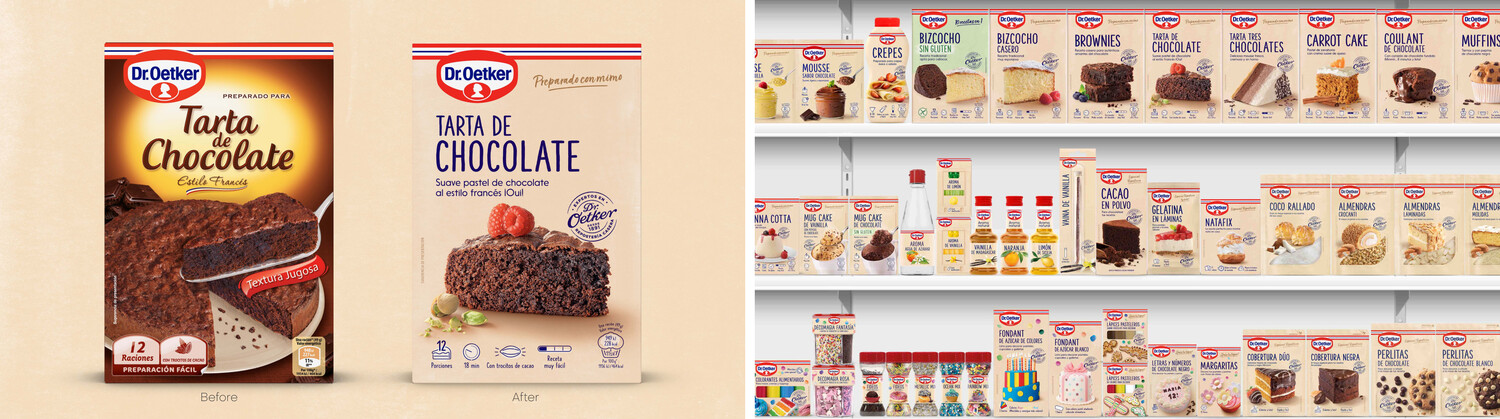
One example is Dr. Oetker, whose global portfolio redesign in 2021 helped drive above-market sales growth (+5%) and significantly increase its market share relative to competitors.
Translated with DeepL.com (free version)
Consistency as a competitive advantage
Ultimately, good brand architecture is an act of generosity towards the user: we make their life easier. It is also a way of providing real direction for the business.
At Batllegroup we believe that only when the system is solid can the imagination run free without fear of getting lost. Because in a complex world, consistency is the greatest competitive asset.